Writing Guide
How a name becomes a photograph becomes two things
Research Foundation: Cheonsang Yeolcha Bunyajido (천상열차분야지도)
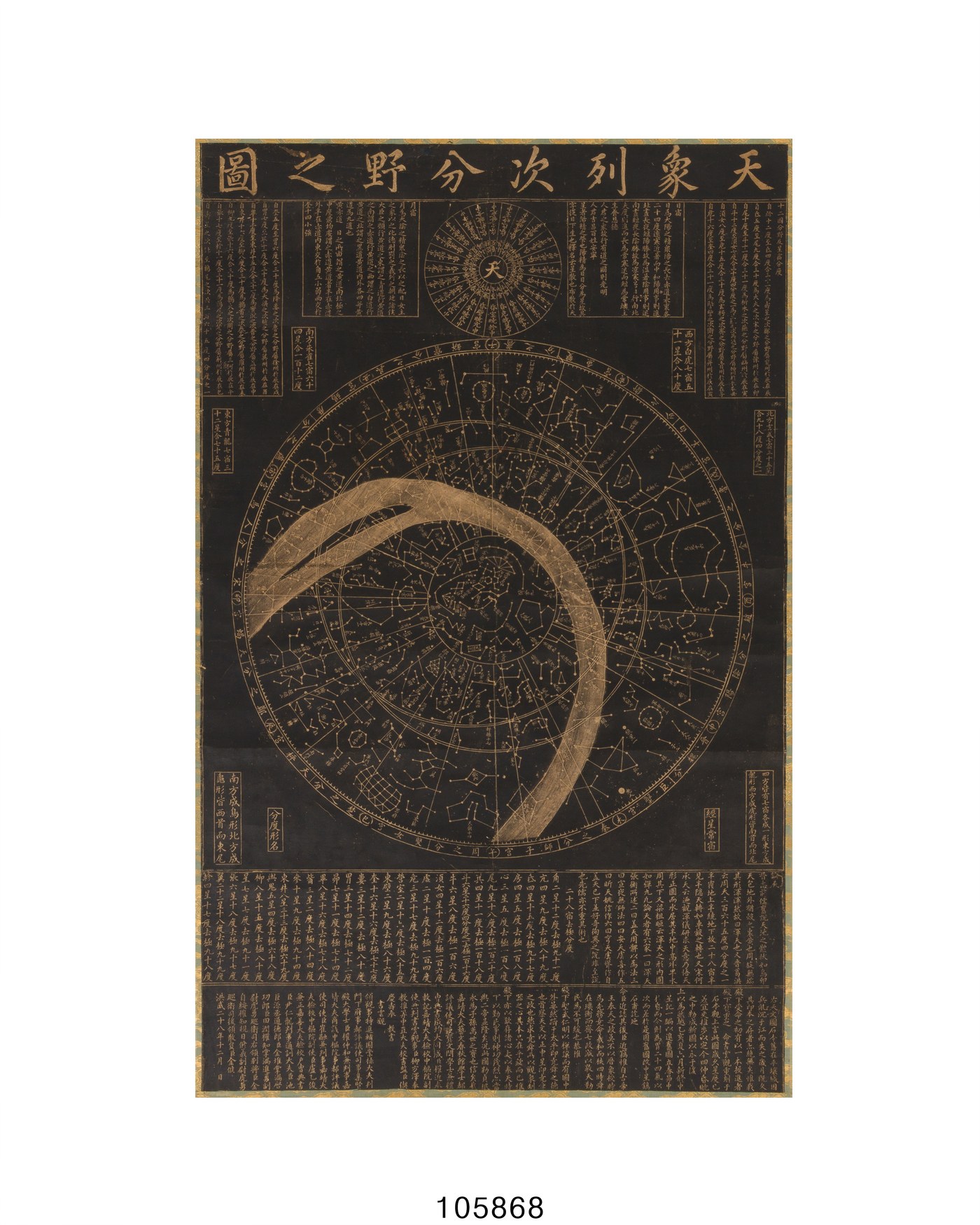
Two different real objects share this name. The original is a stone star chart, carved December 1395, King Taejo's fourth year as Joseon's founding ruler, made by twelve court astronomers including Gwon Geun and Yu Bangtaek. National Treasure No. 128, held at the National Palace Museum of Korea. 1,467 stars, 365 degree marks around the rim, and either 264 or 295 constellations depending on the source, counts vary by edition and this was not resolved to one number. Separately, later Joseon-period paper copies were painted from it, ink on paper in hanging-scroll form. Figure 11 below is a direct look at one such copy, held at the National Museum of Korean Folklore, catalog 민속 105868, 219 by 89 cm overall. It is not the 1395 stone, but it is the same composition, and it is where the Milky Way detail and the exact mansion degree counts below come from. Eleven figures, each one a finding, and what it changes about the writing form or the display itself.
1. One stone, three registers
Star map on top, a table of star and lunar-mansion data in the middle, a preface and a separate essay called "Discourse on Heaven" at the bottom. 211 cm tall, 12 cm thick. A scroll copy of the same composition, Figure 11, also shows a small separate index diagram sitting just above the star map, flanked by the field-allocation text panels.
Design: documentation pairs each photographed chart with a short caption, map and text together, the same way.
2. A galaxy, already drawn
The scroll copy in Figure 11 shows a wide, curved band sweeping across the star field, the Milky Way, rendered directly into the chart six hundred years before this workshop needed one.
Design: the display's nebula and vortex haze are not a modern layer added onto an old form. Something like it was already there.
3. Three hundred sixty five degrees, the length of a year
The circle is not 360 degrees. It is divided into 365 1/4 du, one for each day of the solar year. The same year was also split into 24 solar terms and 72 five-day pentads, hou, a related but separate calendar layer recorded alongside the chart.
Design: neither the rays on the template nor the particle count on the display need to answer to a modern 360-degree grid. The source system counted by the year, not by an arbitrary circle, so a ray count tied to a name's own length is closer to the original than a round number would be.
4. One star, one line to the pole
Four named circles, not decoration: an inner boundary of stars always visible from the capital, the celestial equator, the ecliptic, and an outer boundary marking what was visible at all from that latitude. Star positions were recorded in two numbers, pole-distance degree and mansion-entry degree, close to what a modern chart calls declination and right ascension. Each of the 28 mansions has one reference star. A straight line from that star to the pole is the actual reading method, not a modern reinterpretation, that line is how a viewer finds a mansion's exact position. The twelve Yeolcha field allocations, tracking Jupiter's twelve-year cycle and paired historically with earthly states, are written in the corner text, not marked as a ring on the map itself.
Design: the personal template's rays are not a loose resemblance to this method, they are this method. One reference point, one line to a shared pole, per name.
5. Three enclosures at the center
The region closest to the pole is not empty margin. It holds the Three Enclosures, Purple Forbidden, Supreme Palace, Heavenly Market, named for the emperor's own residence and court. The center of the sky was already imagined as someone's home before anyone's name was added to it.
Design: the template's "keep clear" center can be read the same way, not a blank, but a small forbidden city of one's own, the one part of the chart that belongs only to the person writing it.
6. Twenty-eight mansions, four guardians
The 28 lunar mansions split into four sets of seven, one set per compass direction, each set watched over by a symbolic creature. Drawn here as equal quarters for clarity, but the corner text on the scroll in Figure 11 gives unequal totals, East (Azure Dragon) spans 75°, West (White Tiger) spans 80°. South and North are labeled Vermilion Bird and Black Tortoise on the same scroll, their exact degree totals were not legible enough to transcribe here.
Design: a documented precedent for dividing one shared sky into named, bounded, unequal quarters without breaking the whole, worth keeping in mind if the communal display ever wants grouped rather than purely chronological arrival.
7. Brightness has a size
Star size on the chart scales with brightness, a Korean departure the sources note from Chinese charts of the same era, which drew every star the same size regardless of magnitude.
Design, for the actual display: intensity currently drives glow and little else. Consider letting it scale sprite size too, the way brightness does here, so a more intense entry is not just brighter but visibly larger, not only bloomed.
8. Two epochs, one object
Precession dating shows the equator-band stars still match roughly first-century positions, copied forward through Chinese astronomical records, while the region near the pole was recalculated for 1395.
Design: a participant whose word has an older or ancestral form, a name, a place, a phrase said differently by a grandparent, may note it beside the one they write, the same layering the chart itself carries.
9. Even the center had moved
The reference pole star was nearest true north in 802, and had drifted about three degrees away by the time the stone was carved in 1395. The makers kept using it anyway.
Design: the "keep clear" center on the template is a working reference, not a claim that any point stays perfectly fixed.
10. One chart, many
A single person's text, written radially around a personal center, is one small Cheonsang Yeolcha Bunyajido. Many of them, gathered, is the same structure at the scale of the room, and then the display.
11. The actual object, not a stand-in
A paper hanging-scroll copy of the chart, ink on paper mounted in silk, Joseon period, held at the National Museum of Korean Folklore, catalog 민속 105868. Not the 1395 stone itself, a later painted copy of the same composition. Title at top, a small index diagram with its own field-allocation text panels just below it, the circular star map with the Milky Way band and the four guardian quadrants, then dense data and preface text at the bottom. Every other figure on this page is a schematic drawn from descriptions. This one is the source.
Instruction Card
Print this at table signage size. Plain language, minimal text, works for participants across languages.
How to write your text
Not sure what to write? The poem this workshop comes from counts memory, love, loneliness, longing, poetry, and a mother, before it ever names a single person or place. Any of these can be yours: a name, a place, a word for someone you love, a feeling that means home.
- Mark a small center point on your paper. Leave it empty. It is your fixed point, the pole you write from, the same position Dong-ju writes from in the poem.
- Write your text one meaningful piece at a time, a character, a syllable, or a whole word, each piece on its own ray, spreading outward from that center like a clock face.
- Let the top of each piece point outward, away from the center.
- Write in your own language, your own script. Nothing here needs translating.
- When you are done, photograph the whole page. This one photograph becomes both your individual piece and part of the shared galaxy.
Personal Template
One of these per participant, not a shared sheet. Set the ray count to match how many meaningful pieces, characters, syllables, or whole words, are in the text being written, then print or trace from it directly.
Scale bar shown at bottom right. Print or project at any size, the proportions stay correct.